
Scrap Joint Shift
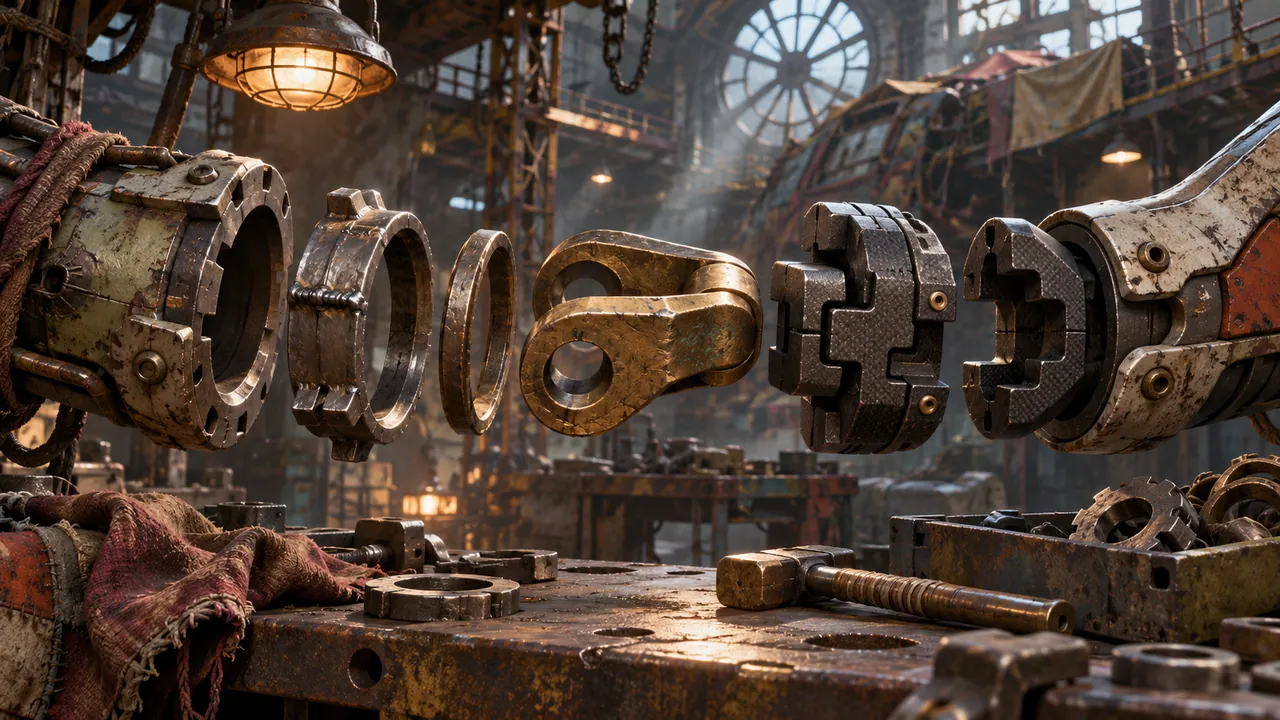
In a fictional bay behind a row of abandoned machines, a crawler still has its shell and most of its fittings. It is missing a joint between a short working arm and the larger part of its frame. That joint must make a narrow turn while the arm passes close to the edge of a bushing. Scrap Joint Shift asks you to recognize the motion that originally fit in the space, pick out a suitable combination of parts from a salvage rack, and give the rebuilt machine its first small task. The concept keeps the whole repair in one area so that you can move repeatedly between the opening, the pieces, and the first trial.
Read the empty seat
Stand near enough to see both the bright edge and the deeper line where a component rested. The bright edge follows most of the rim. The deeper line ends just before a corner. From another angle the two can look like a single shape. The game gives you the outline of the seat as it looks from a useful inspection height, while preserving the darker mark on the surface itself. You can mark those two observations separately and compare which one matches a possible replacement bracket. A part that seems to fit the rim may need a shallower ridge to let it pass the edge of the opening during its turn.
Bring two pieces back from the rack
One bracket has a clean profile and a broad shoulder. Another has a worn edge and two short legs at its base. Hold each against the opening to see what kind of room it would leave. A useful first fit rests at a point that holds the arm in its original line. That line can be seen from far enough away to see how the nearby shell limits the angle. The player can combine a bracket with a sleeve from the rack. When the pieces meet, you can see whether the sleeve leaves an extra opening for the stop or hides it under the larger rim. Keep the earlier view handy so you can compare two plausible choices before using the test.
Move the machine through a short trace
The machine should be able to turn a little and return to the point where it started. We give the scavenger a visible marker beneath the arm. If the two parts settle differently after moving, the marker is a way to make a repeated observation from the same place. Watch the arm through the center and then look from behind the shell. A small gap can appear on the other side as the machine comes back. In the proposed game, you can stop at that point, see which side caught first, and return to the rack without losing the evidence from the old seat. The test has a known short return instead of a job the machine carries out in another part of the room.
Take a useful result forward
This title is an in-development mechanical puzzle set in a made-up world. A successful first turn tells you what the new joint can handle in the space that was tested. You can choose whether to reuse that repair in a later trial with the arm in a higher position. The Empty Bushing describes the difference between a visible rim and a mark left by a shoulder. A Latch Between Materials follows a connection whose shapes came from two different sources. When you review the game, compare the first fit with the result after a return. The player should be able to explain both without memorizing a part code from the rack.