
Frame With No Hinge
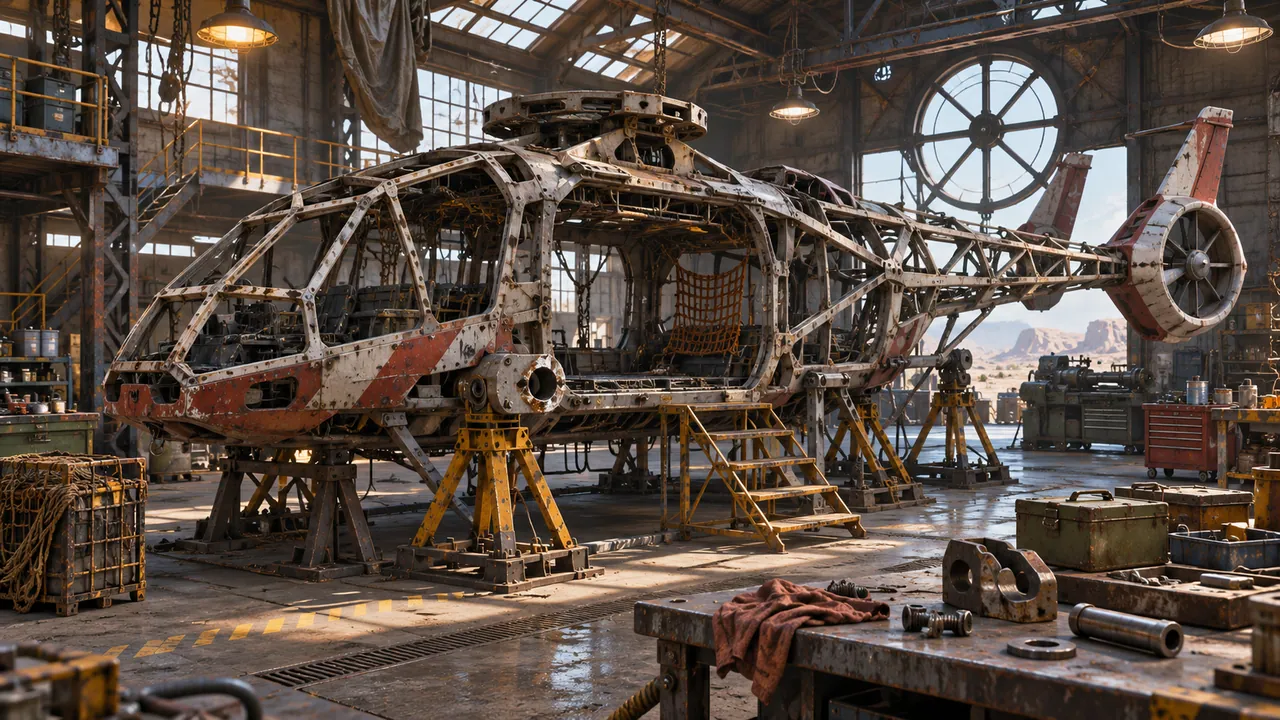
In a side room of the ruins, a discarded salvage machine has lost the support between a broad wing and a short central frame. The wing stays up because one part of the shell sits on an old stand. You can enter the bay, move a temporary support along the floor rails, and compare the empty seat with parts recovered from nearby machines. Frame With No Hinge is a design concept about making a repair when the thing you want to move has to remain supported. The player needs to transfer enough of the load to see the opening without losing the useful position of the frame.
Establish a line that can stay visible
The old stand hides two marks on the inner edge of the wing. Move to the far side of the housing to see a brighter strip on the outer edge instead. Make that strip the first reference. Record where it begins relative to the small housing beneath it. When a support is placed on the floor rail, the next view should still let you compare the housing and the edge. The support can take part of the load without visibly lifting the wing very far. A small change in the shadow tells a player where the repaired position could be. From the close side, that shadow can overlap the deeper profile of the joint, so we keep an alternate view at the rail.
Choose how to replace part of the span
The game offers a bracket with wide shoulders and a thin support with a longer internal stop. Neither fills the whole region between the wing and the frame on its own. A spacer scavenged from an empty rack may make one of them useful if it leaves room for the turn. Before committing to the part, compare what the proposed support would do to the opening on both sides of the wing. Some combinations rest cleanly at the starting position but prevent the wing from returning after it has moved. We let you walk around the machine at the end of the proposed move and examine the gap that the new part would occupy.
Transfer from the stand to the repair
The first short test makes the wing stand against the new connection while the temporary support still limits the total movement. The machine can now be brought a little farther through its trial. If a gap appears, there is a place to check how the shell follows the joint. An apparent fit from the far side can conceal a second movement underneath the frame. Use the original bright strip to judge the direction. The player can stop and put the temporary support farther along the rail before trying again. That gives a meaning to the mark on the floor instead of making it a sign that the whole repair has already succeeded.
Leave an understandable first result
This is an original prototype about examining a small part of a large fictional machine. At the current design boundary, the machine makes a very short movement and comes to rest within the first repair bay. A player who built an alternate connection can see where the weight settles. That is more useful for the next choice than a close-up of the part alone. Under Its Own Weight explains the runs that let us judge that result. Reading a Part by Its Outline examines a comparison that can be made at the rack before the first stage of the repair. Look at those two points in sequence to see what the rebuilt connection is meant to prove.